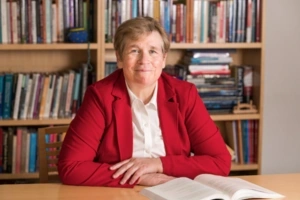
Faculty Expert

It has been a dark season for higher education. Declining birth rates after the 2008 financial crisis have led to a so-called “demographic cliff,” a dearth of 18-year-olds to fill the spots at the nation’s universities. Rising tuition costs and accelerating technological change spurred by AI adoption have fueled public skepticism about the value of a degree. And a president and Congress who have the sector in their crosshairs have made surprising sweeping shifts in federal research funding, international student visas, and student loan policies, causing uncertainty and confusion about the future.
But one silver lining among all these clouds has been community colleges. The National Student Clearinghouse Research Center data show that enrollment is up by 3 percent at those institutions this year. These colleges are creating new programs and credentials tied directly to local industry needs, offering affordable pathways to higher education, and innovating new supports for their students.
“There’s a lot of doom and gloom about higher education right now,” said Penn GSE Associate Professor Rachel Baker, who studies student access to and success in community college. “Higher education is not a monolith, and different sectors are hit differently in different economic times. I think many community colleges right now are okay.”
Built for the Workforce
One reason for the success of today’s community colleges is their closeness to local employers. Unlike four-year institutions, which often define themselves by disciplinary depth or research impact, community colleges were built to respond to labor-market needs in real time.
“We have intentionally developed and strengthened partnerships with employers and industry leaders,” said Peter Jordan, GRD’08, president of Dutchess Community College in New York. “We are working with them to help us develop and strengthen our curriculum so that we are building into our student learning outcomes the skill sets that those employers need. We’ve done it with aviation. We’ve done it with advanced manufacturing and mechatronics. We’re doing it with automotive now.”
For Dione Somerville, GRD’06, president of Owens Community College in Ohio, the relationship with employers is equally direct.
“We are absolutely intertwined with our community,” she said. “What’s happening in our community can’t be separated from what’s happening in our institution.” When new industries arrive or existing ones change, she said, “we have to be prepared to help educate folks for those jobs.”
That readiness often means co-designing programs with employers from the outset. Somerville described a partnership with a hospital system that struggled to recruit workers in a specialized field. “They approached us and said, ‘Would you be willing to start up this program?’” she recalled. “We already had the expertise on our faculty, and it was a relatively quick turnaround to build the curriculum and go through accreditation.”
Another partnership—this time involving municipalities and a regional government council—led to a new certificate in water treatment professions.
“The first cohort was full literally within a week or less,” Somerville said. “Graduates passed their licensing exams and were able to get jobs right away.”
“We’re uniquely situated among higher ed institutions to be nimble partners, to not have to take forever to develop and approve a new degree program or to work with industry on experiential learning,” said Mark McCormick, GRD’17, president of New Jersey’s Middlesex College.
He described a regional partnership with Johnson & Johnson to train workers in aseptic manufacturing. “When you finish all three courses, you get a very high-paying entry-level job,” he said. “You don’t have an associate degree yet, but [your credential] ladders into one, and the industry will then pay for you to continue on to get one.”
For Randi Cosentino, C’95, GRD’11,* inaugural president of the U.S. Naval Community College, such modular options for credentials have been baked into her school, a fully virtual college serving enlisted service members, since its inception in 2020.
“We’re teaching what I call the Naval Core,” said Cosentino. “There are two embedded certificates—a Naval Studies Certificate and a Professional Certificate—which are both stackable, as a part of our associate degree program, and standalone. . . . We believe very much in no dead-end pathways, so everything we do is stackable. Our certificates can become associate degrees, and every one of our associate degrees has at least one guaranteed, high-quality four-year pathway that is seamless.”
Nimble By Design
Speed is perhaps one of the most underrated advantages of community colleges. As industries change—particularly under the pressure of automation and AI—educational institutions are being asked to adapt faster than ever before and to anticipate the skills needed for the jobs of tomorrow. Community colleges are structurally positioned to do exactly that.
“There’s a lot of entrepreneurialism within community colleges,” said Cosentino. “That’s inherently due to their mission from the outset.”
She argues that community colleges move faster precisely because they are accountable to workforce outcomes—even at, or perhaps especially at, her school, which is less “in partnership” with employers than it is embedded within one (the U.S. Navy).
“They know they have to be responsive, because they’re economic engines for their local and regional economies,” she said. “There’s a lot less bureaucracy in them.”
Somerville said Owens was able to scale up an AI certificate series developed in partnership with a regional organization in mere months. Alternately, curriculum changes at a four-year school can take years.
At Middlesex, McCormick explained that AI isn’t being siloed into a single program. “Rather than have an AI curriculum unto itself, we see AI as a tool in every employee’s toolkit,” he said. “We’re teaching students how to use it ethically and appropriately across fields.”
That approach aligns with what Baker sees across the sector: community colleges embedding workforce-relevant skills—including AI, data literacy, and professional competencies—directly into programs. “They’re bringing in people who are actually working in those industries,” she said. “That connection is critical.”
“For degree programs that we’ve had for years, we’re now developing micro-credentials so that they stack efficiently into degrees,” said Jordan. “Students can acquire a skill and go to work, but they’re not locked out of further education.”
Welcoming Students of All Ages and Backgrounds
Community colleges draw from a much broader population than just traditional-age students. They serve adult learners returning to school, students already in the workforce, parents, veterans, and high school students earning college credit (known as “dual-enrollment students”).
“When you look at community colleges and who we serve, we literally serve everybody,” said Somerville. Although the average age at Owens is 24, she noted that the statistic is misleading. “We do have a lot of dual-enrollment students, and we also have 60- and 70-year-olds.”
This means these schools are, in some ways, shielded from wider demographic trends.
“If the demographic cliff is about fewer 18-year-olds,” Baker said, “18-year-olds aren’t the only people who go to community college.”
Cosentino’s students at the U.S. Naval Community College, for example, are exclusively adults. “We are specifically targeted at enlisted service members,” she said. “Men and women, active duty, globally deployed service members who might even be at sea.”
“Largely, our students are first generation,” said McCormick. “They’re folks who come from underserved communities, who need that extra support to even think about going to college, let alone getting through college.”
These students bring experience, but also complexity.
“A lot of even traditional-age students have nontraditional student lives,” Somerville said. “They’re caregivers, they’re working, trying to piece together one, two, or three jobs to make ends meet.”
That reality has forced community colleges to rethink how they support student success.

Wraparound Support
Community college students are more likely to face intersecting financial, mental health, and family challenges. Baker’s research has followed students who leave community college without finishing to find out why.
“It’s never one thing,” she said. “It’s usuallya combination of financial concerns and life complications, layered on top of complex systems that are really hard to navigate.”
Those systems, Baker argues, are often the silent barrier.
“Colleges are incredibly complex environments,” she said. “Federal regulations, state regulations, institutional policies—students are trying to navigate all of this while working, caregiving, and dealing with stress. That complexity can be the final straw.”
Many schools are responding by reframing student success as an institutional responsibility.
“We started the first food pantry at a community college in Ohio in 2012,” Somerville said. The college has since expanded its offerings to include a career- clothing closet, emergency funding, mental health counseling, and sensory rooms for neurodivergent students.
Middlesex has taken a similar approach. “Fifty-one percent of our students reported at least one instance of food insecurity in the last 30 days,” McCormick said. The college now offers a community-resource hub, emergency grants, Chromebook lending, meal partnerships with local faith organizations, and a mental health center with 24/7 virtual support.
“We realize that if students are hungry or worried about where they’re going to sleep, they can’t be successful as students,” he said. At Dutchess Community College, that realization led to a unique-to-the-sector residence hall that operates all year, housing students who would otherwise have nowhere to go. “That residence hall is populated year-round in large measure by student groups that include LGBTQ students who are estranged from their families and foster care alums who have aged out of the system.”
Childcare is also a critical need. According to the 2020 National Postsecondary Student Aid Study, nearly one in five undergraduates is raising children while enrolled, and student-parents disproportionally attend community colleges. At Dutchess, Jordan has not only been raising money to scale up their daycare offerings, but the school has embedded it in the curriculum, too.
“Our childcare program also serves as a lab school for our early childhood teacher education program,” he said. “So at once, we are addressing the literacy rate within our community, we are producing teachers to go into early childhood education classrooms that need them desperately, and we’re promoting workforce and economic development, because those parents can go to work being assured that their kids are getting quality, safe, and affordable childcare.”
Read the rest of the feature in the Spring/Summer 2026 issue of Penn GSE Magazine.
*Cosentino participated in an individual capacity. The statements and opinions expressed are solely those of the interviewee and should not be construed as official positions of the Department of Defense, its components, or the U.S. government.
Media Inquiries
Penn GSE Communications is here to help reporters connect with the education experts they need.