Building on a Strong Foundation of Human-Centered AI Innovation
Across Penn GSE, faculty, students, schools, and partners are designing and studying new approaches to AI in education. The Living Laboratory connects this work so that researchers, educators, learners, and partners can learn across projects, test ideas in authentic settings, and build on what works.
Featured Projects & Initiatives
These initiatives showcase Penn GSE's people-first, education-first approach to AI.

Teacher–Inventor Fellowship
Professional Development | Teaching and Learning | K–12
The Penn GSE Teacher-Inventor Fellowship helps K–12 teachers solve a classroom challenge by turning it into a functional AI-enabled tool. Along the way, fellows receive structured support from Penn GSE students and collaborate with a community of teachers who are inventing for education.
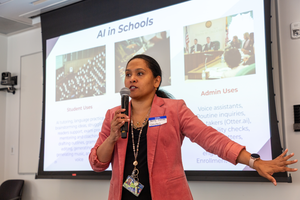
Pioneering AI in School Systems (PASS)
Teaching and Learning | Education Leadership | Professional Development
This innovative professional development program prepares educators, school leaders, and district administrators to use and govern AI responsibly in educational settings. Participants gain the skills to integrate AI tools effectively, develop AI policies and governance frameworks, accelerate learning, and prepare students for the future of work.

Penn GSE AI Pedagogy Initiative
Higher Education | Teaching and Learning
The AI Pedagogy Initiative provides a space where Penn GSE faculty and graduate students work together to design, test, and evaluate AI-enhanced practices in Penn GSE courses—preparing the next generation of teachers, school leaders, researchers, and learning designers.

Philadelphia Writing Project
PreK–University | Teaching and Learning | Literacy
The Philadelphia Writing Project is a network connecting PreK–University and out-of-school-time leaders working to advance writing and the teaching of writing across grade levels and disciplines in Philadelphia and the surrounding area.

UNESCO: Building Capacity for AI in Education
AI Governance | International Development
Our work with the UNESCO UNITWIN Network on AI in Education Unplugged connects research on AI and learning with policy and institutional decisions for education-system transformation, helping educational leaders understand the opportunities and risks of AI, develop institutional capacity, and enable responsible, human-centered adoption in low-resource settings.

AIED Unplugged
Teaching and Learning | K–12
AIED Unplugged explores how the benefits of AI can reach learners when K–12 schools lack reliable internet, devices, technical infrastructure, or specialized expertise. Rather than requiring schools to adapt to sophisticated technologies, the project designs AI approaches around existing educational contexts and constraints, providing a model for equitable, context-responsive AI adoption.

AI Thinkery
Higher Education | Research | Teaching and Learning
A faculty-led initiative that brings together colleagues from across Penn GSE divisions to map the School’s AI-related research, development, and partnerships, and to develop a shared vision for Penn GSE’s role in AI in education.
AI Research and Practice
Across the School, this work spans how people learn, how educators use and evaluate AI, and how educational leaders and systems respond to technological change.
Reimagining How People Learn
CORAL: Embodied AI for Early Childhood Education | Shiyan Jiang
CORAL empowers young children to design physical AI, including humanoid robots, using natural language and body demonstrations. By designing, testing, and redesigning AI behaviors, children develop computational thinking and physical AI literacy while learning a foundational idea: AI is designed, it can be redesigned, and they can have a role in shaping it.
AI Conversational Agents for Young Language Learners | Yuko Goto Butler
Yuko Goto Butler is leading a team of AI engineers, researchers, teachers, and young learners to develop AI chatbots that support oral language development for children learning an additional language. The collaboration centers the needs of young learners in identifying design features that are both age-appropriate and ethically sound.
Wonderbits | Bodong Chen
Wonderbits is an online collaborative environment where students develop, connect, revisit, and reorganize ideas as their understanding grows. Grounded in the Knowledge Building approach, the project is exploring how embedded AI agents can support students’ creative work with ideas while ensuring that students retain cognitive responsibility for their own learning.
Putting Educators in the Driver’s Seat
CraftPad | Bodong Chen
CraftPad is an AI-assisted design workspace that helps K–12 teachers develop and refine lessons with feedback and coaching from AI agents. Designed as a counterpoint to efficiency-driven approaches to AI, CraftPad centers teachers’ professional expertise and judgment, using AI to support iterative design and critical reflection rather than simply generate lessons for them.
Penn AI Pedagogy Initiative (PAPI) | Seiji Isotani
The Penn AI Pedagogy Initiative, led by Seiji Isotani, is developing and studying AI-enhanced learning activities across 18 courses in all four of Penn’s undergraduate schools. The project explores how AI can be integrated into teaching and learning responsibly and effectively, with the long-term goal of creating a shared digital resource for educators across Penn.
Pioneering AI in School Systems (PASS) | Betty Chandy and Lara Paparo
PASS is a three-tier professional learning initiative that helps educators, school leaders, and district administrators build the capacity to develop AI strategies, policies, and classroom practices that are ethical, equitable, and aligned across roles. The initiative approaches AI adoption as a system-wide challenge, connecting decisions about classroom practice with school-level implementation and district strategy and governance.
Building Capacity to Engage Critically & Ethically with AI
Algorithm Auditing for K–12 | Yasmin B. Kafai
Yasmin B. Kafai and Penn Engineering’s Danaé Metaxa developed a code-free approach that helps high school students investigate whether AI systems produce biased or unfair results. By conducting systematic audits of real-world AI applications, students learn that they don’t have to simply accept AI outputs—they can investigate how these systems behave and make informed judgments about whether to trust them.
Critical Evaluation of ChatGPT Outputs | Yuko Goto Butler
Yuko Goto Butler and her collaborators are studying how advanced learners of English evaluate the credibility and arguments of AI-generated academic texts. Early findings suggest that even students who recognize the limitations of AI-generated content can struggle to identify and correct those problems in practice, underscoring the need to explicitly teach students how to critically evaluate AI-generated information.
Preparing Educators and Leaders
AI Integration in Higher Education | Peter Eckel, Matthew Hartley, and Ross Aikins, with Qatar Foundation WISE and IIE
Qualitative research on how higher education institutions are using and governing AI.
Priming Leaders and Organizations for AI Adoption | Sharon M. Ravitch
Helping leaders and organizations in the U.S. and India build “AI Prosilience” and effective AI adoption strategies.
Degree Programs and Professional Development
Penn GSE's commitment to AI education extends beyond research and innovation. The School prepares current and future educators through academic programs and professional learning opportunities, including the online Learning Analytics and Artificial Intelligence, M.S.Ed. program, the Pioneering AI in School Systems (PASS) program, Implementing AI in the Classroom certificate, and the Adaptive Learning Environments course.
Collaborate With The Living Laboratory
We partner with schools, districts, universities, governments, nonprofits, foundations, and industry leaders to explore how AI can support meaningful and responsible educational transformation.


