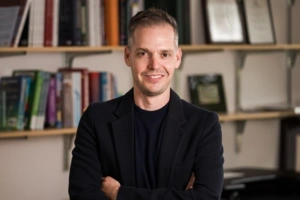
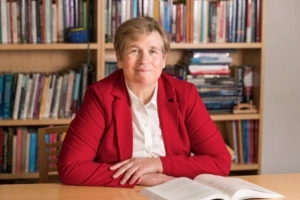
The 670 graduates received one final lesson on their role preparing democratic citizens—and restoring public trust in education—from Dean Strunk and speaker Denise Forte.
Darin Brawley, Shai Reshef, and Michael Webber are recognized for their pioneering contributions that have advanced learning opportunities and impacted countless lives.
Seven finalists pitched their ventures live at the University of Pennsylvania, marking the first time the competition has returned to campus since the COVID-19 pandemic.
In this episode of The PennCLO podcast, HR executive and scholar–practitioner Dr. TJ Lintz joins Dr. Sharon Ravitch to explore how leaders transform moments of extreme disruption into catalysts for long-term organizational evolution.
This article cites Sharon Ravitch's book, Applied Research for Sustainable Change, in explaining what practitioner-led qualitative inquiry is and why it's a better way for leaders to understand organizational culture and their people's perspectives.
School and Mental Health Counseling student Madison McTier helps young students in local public schools improve social skills, emotional regulation, and self-advocacy through her role on the Netter Center for Community Partnerships’ school-based mental health and supportive services team.
Ariane Thomas discusses mental health issues in the city of Philadelphia and training school and mental health counselors on how to address mental health both on the local and global level.
Laura Perna says that one effect of Tennessee's free community college programs is their attraction to students instead of a traditional, private 4-year college education.
The assistant professor's research explores how to make evidence-based mental health care more effective and more accessible for children, adolescents, and families—and why early support can change lives.
In honor of America’s 250th Birthday, Professor Jonathan Zimmerman takes a look back at the history of civics education, which is almost as old as the country itself.
Expressing concern over the government effectively shutting down schools that don't generate salary boosts for graduates, Jonathan Zimmerman points out that "The purpose of college is not simply to obtain a high-paying job. It’s to cultivate free-thinking minds."
Calling AI "kind of a Wild West," Jonathan Zimmerman says schools have been too quick to adopt AI into classrooms before knowing whether it promotes or inhibits learning and under what conditions, adding that the price tag attached incentivizes schools to answer that question affirmatively without digging too deep.
Penn GSE Associate Professor Justin Parent investigates how parenting, sleep, and childhood adversity become biologically embedded, with the goal of identifying opportunities to intervene early and help children thrive.
Ericka Weathers says that existing scholarship suggests that financial incentives can encourage desired behavior, particularly in the short term, but the effectiveness depends on how the incentive is structured and the behavior being targeted.
Karen Weaver says college athletics programs can no longer afford to redirect some donor money to academics in the current system, but are now incentivized to spend every dollar they bring in trying to get a competitive advantage.
Language, Globalization, and Intercultural Studies master's students spent the summer expanding their practice and learning from and with people and communities across Philadelphia.
Michael Gottfried says that one driving cause of absenteeism in schools is that the pandemic changed social attitudes and stigmas around physical and mental health and the classroom, adding that another cause is a growing rift between teachers' and students' attitudes toward schools.
Commenting on a recent report from the School District of Philadelphia showing some students in the Summer Achievers program experienced more learning loss in reading than district students overall, Jon Supovitz says the report does not actually include enough data to assess the program's impact on students one way or another.
Associate Professor Wendy Chan is the lead statistician on a project testing school-based programs to help students who have difficulty with organization, time management, and planning.
Sarah Schneider Kavanagh says the structure of a modern school day is now “incredibly reliant” on educational technology platforms, and there's currently not enough evidence to support ed tech companies' argument that this will benefit student learning.
A multidisciplinary group of education scholars, a dash of skepticism, and a whole lot of curiosity are powering Penn GSE’s newest space for imagining smarter, more human-centered uses of AI.
Seven finalists will compete at the live pitch event on Monday, September 14, at the University of Pennsylvania, marking the first year the competition finals and Catalyst Innovation Summit join together.
Discussing the return of Pizza Hut's Book It! program to get kids reading, Amy Stornaiuolo explains that extrinsic motivation alone isn't enough to build sustainable reading practices in children but can help as part of a larger whole.
In this episode of The PennCLO podcast, Dr. Sharon Ravitch is joined by Dr. Marikay Forst, a distinguished leadership expert and author of the groundbreaking chapter, "Architecting Dissent by Design: Psychological Safety, Diverse Thinking, and Brave Cultures," featured in the book Leaders as Architects of Change.
The Learning Analytics and Artificial Intelligence master’s student presented her research on AI-powered learning in South Korea as one of just nine accepted submissions for the conference’s Practitioners, Industry, and Policy track.
6abc Action News spotlighted The Academy at Penn, noting that the program's first cohort has achieved 100% placement at a meaningful hands-on learning site.
Karen Weaver discusses the multiple challenges facing Wake Forest University's athletics department in the NIL and conference realignment era as its new president takes over.
Penn GSE and the School District of Philadelphia are co-creating solutions—in areas from algebra to AI—by listening first, aligning priorities, and turning research into real-time change across an urban school system.
Robert Zemsky says that many students are dropping out or transferring before completing four years of traditional college, hence describing the failing college model as "product rejection."
In making the announcement, Vice Dean of Executive Programs Laurie Hall praised Richard’s leadership, expertise, and commitment to the program as interim director over the past year and as associate director before that.
Laura Perna says that along with financial resources, advising students on which courses to take and other ways to prepare for college are equally important factors in making students college-ready.
Facilitated by Catalyst @ Penn GSE and funded by Remake Learning, the initiative will convene superintendents, Intermediate Unit and district executive leadership teams for a one-year research–practice partnership learning ecosystem integrating systems thinking, adaptive leadership, and neuroscience-informed leadership strategies.
Kemi Oyewole discussed her thoughts on instructional coaches, the role of an instructional coach, how to bring morale and community in education, and how she got into her profession.