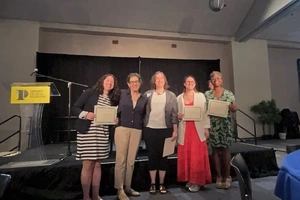
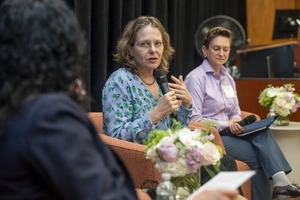
The newly endowed faculty chair, made possible through a generous gift from Andrea Pollack, C’83, L’87, GED’17, and Adam Usdan, will support innovative research, teaching, and leadership in the field of special education.
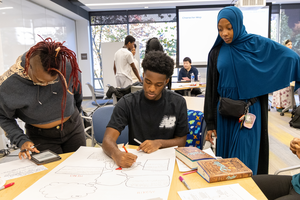
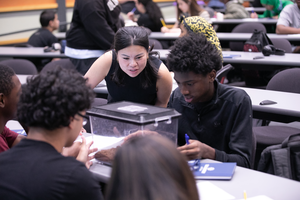
Students in Jen McLaughlin Cahill’s course on YA literature, media, and culture welcomed ninth-grade students from Science Leadership Academy at Beeber into their classroom for discussion and activities focused on Ibi Zoboi’s "Pride."
Penn GSE’s Yasmin Kafai—in collaboration with Danaé Metaxa from Penn’s Computer and Information Sciences department and high school computer science educators across the country—developed the “AI Auditing for High School” curriculum to introduce students to algorithmic bias and guide them through hands-on audits of real-world AI applications.
Michael Gottfried says a large and growing body of research demonstrates the benefits of assigning students to teachers who share their racial or ethnic backgrounds, ranging from improved test scores and attendance to reduced suspension rates and higher graduation and college enrollment rates.
In Mark Cuban's article discussing the importance of AI, Angela Duckworth's comments on AI's usefulness as a pedagogical tool from her 2025 Penn GSE Commencement speech are quoted.
Michael Gottfried says that parents are often unaware of their children's school absenteeism and discusses the effect this can have on students' learning.
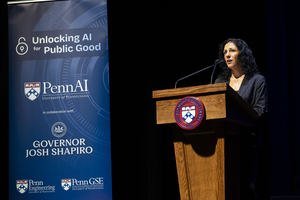
Penn GSE was one of the hosts—alongside the PA Governor’s Office, Penn Engineering, and PennAI—of the “Unlocking AI for Public Good” summit at which experts from around the University and policymakers from throughout the Commonwealth explored how generative AI can be responsibly harnessed for public benefit.
The professor of literacy education says that it should be up to individual teachers to influence how AI will be used in their classrooms rather than enforcing institution-wide technology policies.
Michael Golden says that by equipping educators with the tools, knowledge, and ethical frameworks they need, the PASS program is helping to shape a future where AI enhances learning and promotes equity in every classroom.
With this new funding, the Pioneering AI in School Systems (PASS) program will expand to five school districts or regions across Pennsylvania, New Jersey, and Delaware in December and will be offered free of charge to participating districts.
Lecturer in Literacy Studies Jessica Whitelaw, a literacy coach and former middle school teacher, shares how to combine art with texts to maximize critical inquiry and the imagination.
Seeking the best way to conduct research that would support Latinx students, Professor Nelson Flores has made a career of studying bilingual education.
A new study coauthored by Penn GSE’s Michael A. Gottfried is the first to show that teachers’ ability to teach in students’ home language, combined with a shared racial or ethnic background, drives greater academic gains.
The alum and digital literacy specialist at Philly's Marian Anderson Neighborhood Academy gives us a tour of the multidisciplinary makerspace where he works, using its technology and tools to involve students in hands-on learning.
Professor of Practice Anne Pomerantz, an applied linguist, teacher educator, and longtime language teacher, provides advice on how best to employ AI in teaching languages—and when human instruction works best.
Rapelang Rabana and Joe Wolf, Dr. Cathy N. Davidson, and Dr. Frederic Bertley are recognized for their pioneering contributions that have advanced learning opportunities and impacted countless lives.
The 2025 Library of Congress Literacy Awards recognized both Penn GSE’s Philadelphia Writing Project and a startup founded by alum Rina Madhani, GED’19, for their contributions to literacy and community engagement.
Philadelphia Superintendent Tony Watlington tells ABC News about the district's PASS Program partnership with Penn GSE to train its teachers and leaders in AI.
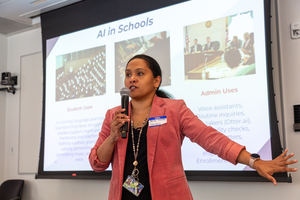
Penn GSE's Pioneering AI in School Systems (PASS) program helps local teachers and school and district leaders build competence in AI governance, policy, oversight, and practical application.
Betty Chandy, featured in WHYY's "The Pulse" around the 25th minute mark, says that teachers must turn their focus on the process of learning rather than the product of learning.
The five-year program kicked off this summer with programming that empowered adolescents to assess their skills and imagine what’s possible for their careers.
A global leader in intelligent tutoring systems, Isotani joined the Penn GSE faculty this summer, drawn by the School’s commitment to rethinking education through innovation.
The Philadelphia Inquirer interviews new Philly teachers Faith Applegate and Sophia Leung, current Urban Teaching Residency program students who co-founded a group for aspiring teachers as Penn undergrads.
The Philadelphia Inquirer covers the first cohort of the Academy at Penn, a college- and career-readiness program for Philly students from underserved communities, with one participant calling the program “a 10 out of 10.”
Former Dean Pam Grossman comments on what drives people to get into the field of education in an EdWeek article that asks “Can Gen Z Be Enticed to Teach?”
In an interview with NBC10 Philadelphia, Joy Anderson Davis, a senior instructional math coach at Penn GSE, shares tips for parents to help their kids continue to learn during the summer months.
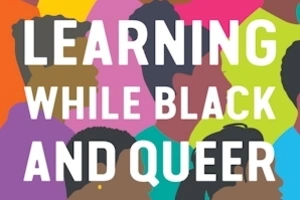
The latest book by the associate professor, who is also a Penn GSE alum, outlines common obstacles to educational equity for Black, LGBTQ+ youth and suggests research-backed guidance for their teachers to help foster their success.
The list of 17 Fulbright recipients from Penn so far this year includes two Urban Teaching Apprenticeship alums from the Class of '22: Emily R. Antrilli and Emma Steinheimer.
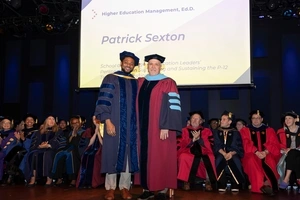
As he steps up his role from executive director to assistant dean for teacher preparation and undergraduate education, Sexton is using what he learned completing his executive doctorate over the last two years to “lean into strategic thinking.”
The Boston Globe’s editorial board praises Robert Zemsky’s College-in-3 initiative and advocates for Massachusetts regulators to allow colleges and universities to begin rolling out more three-year bachelor’s degree programs.
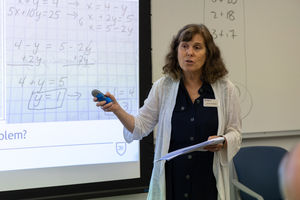
Janine Remillard says that in many math classes, a small handful of students answer all the questions, while those who either don’t understand, are less interested, or need more time tend to zone out. She provides insight into instructional strategies she uses in her math teacher training classes.
Penn GSE welcomed scores of alumni back to campus to celebrate, reconnect, and learn from a timely faculty panel about how educators can facilitate open and constructive classroom conversations during polarized times.
Amy Stornaiuolo notes the importance of fan fiction and other engagement in communities around popular media as an important way that young people build literacies and provides ways teachers can leverage the energy students bring to fan texts.
Artificial intelligence tools can generate lesson plans in an instant—but that doesn’t ensure high-quality, enriching, and contextually relevant instruction. Bodong Chen provides advice on how to create engaging, effective, and contemporary lesson plans using AI.
Penn GSE, at the School District of Philadelphia's request, is offering eighth- and ninth-grade Algebra 1 teachers a fellowship designed to teach them different ways to explain algebraic functions.
With funding from the Neubauer Family Foundation, the program was created in direct response to the School District of Philadelphia’s call for targeted support in Algebra 1 instruction.