A new book from Penn CLO faculty based on alumni dissertations argues that, in an era defined by volatility, leaders must become designers of systems that foster connection, resilience, and continuous learning.
Drawing on her nationally recognized expertise as an economist of education, Dean Katharine Strunk warns that a new federal proposal misclassifies education degrees and threatens the pipeline of counselors, principals, and mental health professionals.
In Chalkbeat, Penn GSE graduate Nimet Eren, now principal of Kensington Health Sciences Academy, is featured for leading a school initiative that helps students identify AI-generated misinformation and critically evaluate online content through a new media literacy curriculum.
During a recent “inquiry day” at nearby Penn Alexander School, students in SLP had an immersive opportunity to observe and report on the real-world impact of the leadership frameworks they’ve been studying.
A new series spotlighting the unique offerings and pedagogy of Penn GSE courses kicks off with a spotlight on Julie Wollman’s class on leadership in higher education.
We gathered four Penn GSE alumni, now serving as college presidents, to discuss the current state of higher education, the evolving demands of academic leadership, and how the presidency is a calling, not just a career.
Now that student-athletes are eligible for direct payments from some schools, as well as lucrative endorsement deals, is the age of the amateur over? How will colleges and universities navigate this new normal and the inequalities inherent in this revenue-sharing era?
At a ceremony at the Morgan Library & Museum in New York City, Cathy N. Davidson, Frederic Bertley, Joe Wolf, and Rapelang Rabana were honored with this year’s McGraw Prizes in Higher Education, Lifelong Learning, and Pre-K–12 Education, respectively.
Vivian Gadsden has been appointed the vice president of the National Academy of Education. Dr. Gadsden co-directs the Penn Early Childhood and Family Research Center.
Principal Julia Snyder, GED’10, discusses the gains of today and the plans for tomorrow at the Henry C. Lea School in West Philadelphia, one of Penn GSE’s partner schools.
Dean Strunk says that developing strong partnerships is person-dependent and takes time to build trust and repair past areas that may be lacking in trust.
The alum of the Mid-Career Doctoral Program in Educational Leadership founded a social impact firm advancing youth voice and agency in philanthropic practice.
The alum of Penn GSE's Executive Doctorate in Higher Education Management who grew up in a small village of cocoa farmers in Ghana recently built a road to connect children in his village to their education.
John Silvanus Wilson Jr., a nationally recognized leader in higher education and former president of Morehouse College, has been appointed the next executive director of the McGraw Center for Educational Leadership at Penn GSE.
A proud graduate of Penn GSE’s Executive Doctorate in Higher Education Management, Hall comes to the School from Penn’s Division of University Life, where she served as assistant vice provost for strategic planning and operations.
Penn GSE's Global Higher Education Management program is preparing the next generation of university leaders to thrive in a rapidly changing, interconnected world.
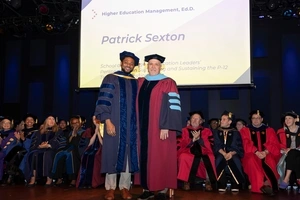
As he steps up his role from executive director to assistant dean for teacher preparation and undergraduate education, Sexton is using what he learned completing his executive doctorate over the last two years to “lean into strategic thinking.”
For this new certificate, the School has partnered with the Association for Talent Development, the world’s largest association dedicated to those who develop and enhance employee knowledge and skills.
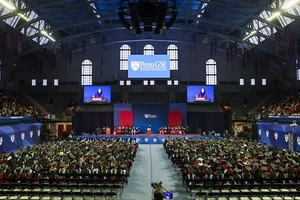
On May 17, in the Palestra, Penn GSE commemorated the achievements of the roughly 700 master’s and doctoral graduates at this year’s Commencement ceremony.
Julie Wollman notes that, "The pressures on a president are entirely different from a provost’s, given the public attention, the much heavier stress, and responsibilities," and speculates that Rutgers will choose someone who has already proven they can do the job for their next president.
Professor of Practice Andrea Kane emphasizes the importance of educators and school leaders engaging with themselves, each other, and their school communities to navigate district policies, state laws, and complex or controversial topics in the classroom.
Kemi Oyewole’s past studies in economics and organizational structures and experience in the Boston Teaching Residency stoked a passion for improving educator professional development.
Michael Gottfried joined education leaders to address chronic absenteeism, emphasizing the importance of collaboration across schools, communities, and government to break down barriers and improve attendance.
The first-of-its-kind program aims to support university presidents and senior higher education leaders in championing transformation and innovation within their institutions.
This year’s theme, “The Leadership Moment,” addressed significant challenges in the field, from the enrollment cliff to school mergers and acquisitions and speech freedom.
Dr. Lilian Ajayi Ore has worked with the UN, established a foundation advocating for youth and women’s rights, and now works as a research scholar. She says Penn CLO’s practitioner–scholar approach has had a profound impact on her work.
Julie Wollman emphasized that university presidents now face heightened complexity due to societal shifts, including political polarization and a decline in respectful discourse, and must exhibit strong principles, interpersonal skills, transparency, and a proactive approach to foundational leadership functions rather than reactive crisis management.
The podcast was recently renewed for a second season after a successful pilot run, and producers are planning an even more engaging and interactive experience for listeners.
Andrea Kane emphasizes "humanizing" opponents by seeing them through a personal lens, fostering respect and empathy. She advocates for setting ground rules and focusing on shared values to promote productive, rather than destructive, disagreements.
Peter Eckel writes that University presidents must actively collaborate with faculty and faculty governance bodies during a crisis to ensure the best outcome for the institution.
South Korean higher ed policy officer and Global Higher Education Management student Yangju Yi describes the master’s program as “eye-opening,” while her policy experience has enriched the class experience for her peers.
As more students plug queries into ChatGPT and other artificial intelligence (AI) tools, it’s time for more faculty and schools to catch up and offer a roadmap on fair and ethical usage.
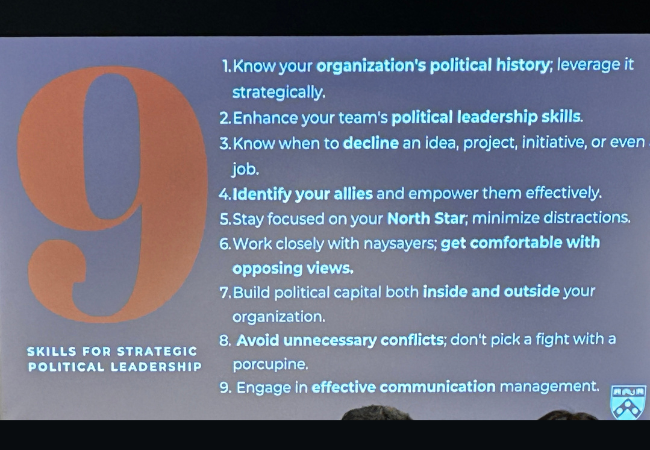
The McGraw Center's inaugural symposium, led by Cheryl Logan, focused on equipping education leaders with the skills needed to navigate the political landscape, improving student experiences and leader longevity in the field.
Gard developed the Financial Viability Index, a color-coded tool designed to help small, tuition-dependent colleges analyze their financial health efficiently and take actionable steps to avoid closure.
Sigal Ben-Porath recommends clear communication and contextually relevant discussions as strategies for universities to navigate the complexities of free speech on campuses.
Peter Eckel notes the exceptional nature of governance problems at North Idaho College, stressing that institutions cannot endure under poor governance. He highlights the pivotal role of board-president relations, which were notably strained at the college, impacting its operational effectiveness and accreditation status.