Honors from AERA, Penn AI, Penn Alumni, and national organizations highlight faculty and staff contributions across education research, artificial intelligence, and public engagement.
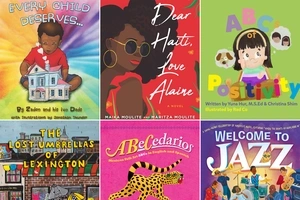
This course encourages students to discover and revisit a wide range of children’s literature across genres and to consider their implications for classroom literacy instruction.
In a Substack essay examining the decline of reading instruction in American schools, Richard Ingersoll’s research is referenced in a discussion of broader shifts in teaching practices and the challenges schools face in sustaining strong literacy instruction.
Bad Bunny’s recent Grammy wins and Super Bowl performance may have thrust multilingualism into the headlines, but educators have worked in linguistically diverse classrooms for years. Betsy Rymes has advice for navigating your multilingual class.
Two Penn GSE alumni and teacher leaders with the Philadelphia Writing Project (PhilWP), housed at Catalyst at Penn GSE, will be featured on the opening panel at the Civic Learning Week National Forum, hosted in Philadelphia on March 9, 2026.
Sharon Wolf says the world has failed to meet its promise to eliminate child labour by 2025, with research suggesting that hundreds of millions of children remain in work globally, underscoring the need for stronger enforcement, social protection, and investment in education.
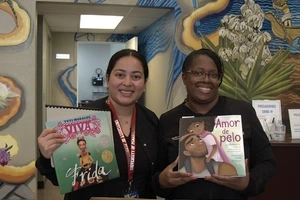
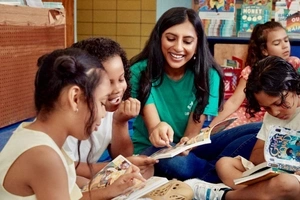
On CBS News Philadelphia, alumna Sibylla Shekerdjiska-Benatova and her nonprofit, A Book a Day, were featured for their work helping West Philadelphia children better understand their world through access to books and literacy programming.
Betsy Rymes discusses how language shapes our understanding of the world and why it can never be neutral, exploring the powerful role language plays in culture, identity, and education.
In WHYY-AM, Jen McLaughlin Cahill reflects on the enduring impact of A Wrinkle in Time, showing how the beloved novel—and the Arden Theatre’s stage adaptation—serves as both a mirror and a window for young audiences by inviting them into imaginative worlds and fostering empathy through storytelling.
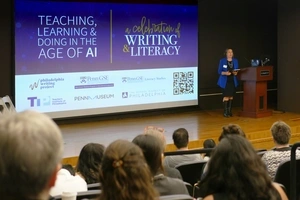
Digital literacies expert Amy Stornaiuolo provides a framework to help teachers design writing assignments that ethically incorporate—or creatively dissuade—use of generative AI.
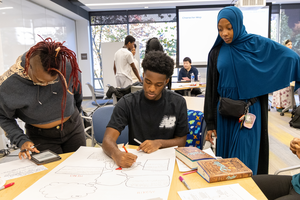
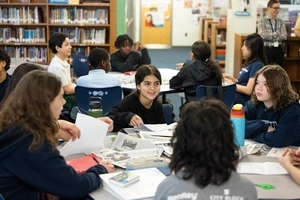
Students in Jen McLaughlin Cahill’s course on YA literature, media, and culture welcomed ninth-grade students from Science Leadership Academy at Beeber into their classroom for discussion and activities focused on Ibi Zoboi’s "Pride."
Lecturer in Literacy Studies Jessica Whitelaw, a literacy coach and former middle school teacher, shares how to combine art with texts to maximize critical inquiry and the imagination.
Seeking the best way to conduct research that would support Latinx students, Professor Nelson Flores has made a career of studying bilingual education.
Professor of Practice Anne Pomerantz, an applied linguist, teacher educator, and longtime language teacher, provides advice on how best to employ AI in teaching languages—and when human instruction works best.
The 2025 Library of Congress Literacy Awards recognized both Penn GSE’s Philadelphia Writing Project and a startup founded by alum Rina Madhani, GED’19, for their contributions to literacy and community engagement.
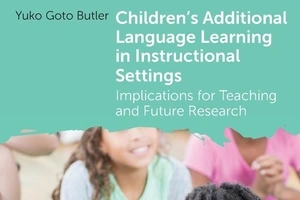
The professor’s latest book gathers research on language development and pedagogy among children learning a foreign language and presents it in a manner that bridges research and practice.
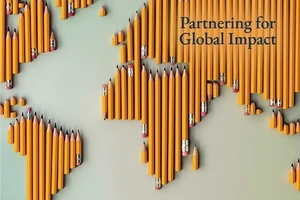
Penn GSE professors and programs are engaged in more than 150 international partnerships and projects in more than 60 countries around the globe. The goal? To change the world through education.
The newly named office in Catalyst @ Penn GSE merges the expertise and expands the impact of two offices: the Penn Literacy Network and the Center for Professional Learning.
Arrington aims to inspire students to think independently and be creative while demystifying and critically examining academic institutions’ expectations for writing and literacy.
Kandi Wiens discusses how emotional intelligence can help individuals build resilience and heal their relationship with work, as outlined in her new book, Burnout Immunity.
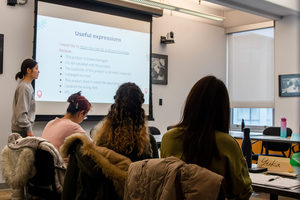
The Practical English for Daily Living (PEDAL) program at Penn GSE provides an opportunity for TESOL students to practice their teaching with language learners across the University and around the world.
As teachers and researchers, Penn GSE alumni are at the forefront of the movement to educate savvy news readers who can parse fact from partisan fiction.
Nelson Flores’ Becoming the System examines how bilingual education has historically framed Latinx students through a deficit lens, urging new narratives that empower students to define their own identities.
The institutions’ memorandum of understanding is being renewed following a literacy and community engagement research conference held at Penn Oct. 14–15.
Educators face mounting challenges navigating political and social discourse, and this fall will test them. Abby Reisman offers four ways to open classroom conversations.
Topics like the upcoming presidential election may lead to difficult discussions in communities and classrooms. Jonathan Zimmerman offers advice on how to facilitate constructive dialogue among your students.
Howard Stevenson promotes racial literacy to address racial conflict, focusing on understanding motivations behind harmful actions and combining accountability with education.
The Philadelphia Writing Project will collaborate with local partners to document and highlight the hidden stories of Black youth, supported by a grant from the Spencer Foundation.
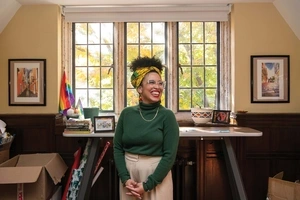
Cortes transforms her office into a dynamic cultural hub, where academic insights and personal touches spark conversations and foster a sense of belonging among students.
Penelope Lusk, a Ph.D. candidate at Penn GSE, has been awarded a 2024 Queen Elizabeth Scholarship for a year of study at the University of Oxford in England.
As schools find themselves at the epicenter of debates surrounding issues like race, gender and sexual orientation, educators must grapple with the challenges of a rapidly politicized classroom environment.
Meresa García, an Urban Teaching Apprenticeship Program student at Penn GSE, has embarked on a mission to promote literacy and education in Philadelphia. Her journey into advocacy was ignited by her lifelong love for books and her realization of the challenges facing public school students in the city.
Organizers are seeking presentations of original curriculum, research, or pedagogy related to re-establishing school and classroom communities as authentic, positive, and nurturing spaces. Submissions are due Aug. 18.
Doctoral student Barrett Rosser and the Philadelphia Writing Project are expanding the notion of literacy to help young Black women express self-love, build community and foster their identities.
Most adults think Black History Month is integral to the American story — but they disagree over whether it gets too much attention, according to a recent survey focused on polarization around American history and how to defuse the culture wars.
The results mean public schools need to do a better job of teaching both the history of minority groups and “what binds all of us together,” says Professor Jonathan Zimmerman, a #PennGSEExpert in the history of education.